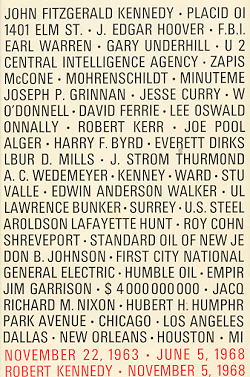
Farewell America
3
King
The only glory in public life is that which portends the future and blazes a path through the haze of the present.
DISRAELI
Senator Kennedy won the 1960 Presidential elections by an "exquisitely narrow" margin. (1) White, Protestant Americans can legitimately claim that he was not their President. Kennedy was elected with the votes of 70% of the Negroes, 78% of the Catholics, and 80% of the Jews, not to speak of the women. For what American woman wouldn't have wanted to be the mother, the wife, the elector of this gracious young man who, while campaigning in Boston, invited the ladies to step up to the platform one by one so that he, his mother and his sister might have the pleasure of making their acquaintance and of taking tea with them afterwards?(2)
For his father, Joseph P. Kennedy, one of the twenty richest men in the United States, wealthier than Rockefeller or Henry Ford, richer than the Pews, the Harrimans or the Whitneys, there were no accidents in politics -- only money and organization. John Fitzgerald Kennedy wanted to become President almost as much as his father wanted him to, no matter what road he had to follow.
And he followed it. During the Kennedy campaign, you couldn't take three steps without running into a Kennedy banner, a Kennedy poster, a Kennedy brother or an employee of the Kennedys. Kennedy was seen, Kennedy was heard, and in some cases it was even possible to sleep with Kennedy. Kennedy spoke several times a day, and everyone talked about Kennedy for the rest of the day. The Kennedys were a new breed of politician. They had as much money, or more, than the best of the professionals, and they developed an electoral machine more powerful and efficient than any before. If we are to believe Victor Lasky, old Joe Kennedy once declared, "Three things are needed to win an election. The first is money, the second is money, and the third is more money." Lasky claims that with the millions he spent for his son John, Joe Kennedy could have had his chauffeur elected to Congress. Senator Humphrey's bus was no match for his opponent's Convair.
There is some truth in these sarcasms, but John Kennedy was the only Democratic candidate who could have beaten Richard Nixon in 1960, no matter what the sums involved. At that time, John Kennedy already had a remarkable knowledge of politics, the daily diet of his family. To his technique, perfected by fourteen years in Congress, he added a total faith in his destiny. During the 1960 Democratic Convention, three candidates arrived almost simultaneously at Los Angeles air- port. Stevenson 's first words were, "I do not want to be chosen, and I have come here almost incognito." Johnson said, "I'm sorry to be late, but I've just been traveling all over the country." Kennedy declared, "I am here to receive the nomination."
In Congress, no one could decide whether he was a liberal or a conservative. A member of the Democratic Party, he often voted with Harry F. Byrd, the leader of the economy bloc. His vote in June, 1960 with Senator Williams of Delaware on a matter as controversial as the oil depletion allowance was surprising, but Senator Williams' bill was rejected by a wide margin, and it was thought that Kennedy had only been employing clever tactics.(3) He had voted against a similar bill in the past, and everyone remembered that he had supported the Republicans in the House of Representatives by voting against statehood for Hawaii, and against the censorship of Senator McCarthy. In short, it was said that he was independent because he could afford to be. This reasonable explanation satisfied even his toughest critics. He was on friendly terms with everyone, and in particular with the committee chairmen, who appreciated his courtesy and his attention. He was not as experienced as Senator Anderson, or as good a speaker as Governor Clement, or as popular with the farmers as Hubert Humphrey, but he was John Kennedy, the handsomest man in the Senate, a veteran of the war in the Pacific, the winner of a Pulitzer prize. Another millionaire, Henry Cabot Lodge, had money, but not as much as Kennedy. The power of the Kennedys could work magic, as Edward Kennedy's election to the Senate in 1962 was to prove.
President Kennedy would probably have preferred that his younger brother wait two more years, but he yielded to family pressure and, in the best Kennedy tradition, the organization was set in motion. There was more to this organization than just dinner parties and beautiful women. With rigorous pragmatism, the Kennedy Brain Trust analyzed the problems at hand and determined the most effective action. The power of the Kennedys had become a political reality capable of upsetting the traditional electoral scales.
Certainly, America had known other dynasties in the course of its history. There had been the Adams, the Harrisons, the Roosevelts and the Tafts, but the potency of these families manifested itself only once in a generation. John Adams was elected President at the age of 61, and his son John Quincy Adams did not enter the White House until he was 57, and without having played a real role during his father's term in office. William Henry Harrison entered the White House at 68, and was followed only by his grandson at the age of 55. The Roosevelts, Theodore and Franklin, were only distantly related. As for the Tafts, they exercised their power in different spheres: William Howard was President, Robert a Senator, and in 1962 Robert A., Jr. was only running for the House of Representatives.(4) That same year Edward Kennedy, aged 30, took his seat in the Senate. Robert Kennedy, 36, occupied the post of Attorney General under his brother John, making the Kennedys the most powerful family in the history of the United States, and probably in the history of the world.
Chief of the most powerful nation in the world, Commander-in-Chief of her armed forces, alone responsible for the use of nuclear weapons, directing relations with more than one hundred foreign governments, distributing more than ninety billion dollars a year through 2.5 million federal employees, living in a 132-room mansion, traveling in two jet planes or in one of the ten helicopters in his personal fleet, John Fitzgerald Kennedy was the most powerful man in the world.
The voters liked the idea that John Kennedy was the great grandson of the owner of a barroom and accepted the fact that his father had made his fortune as a bootlegger and had played the stock market when he was Ambassador to London. The average American, raised in the belief that the way money is earned has nothing to do with morality, saw nothing frightening about this. The rise of the Kennedys was in the best American tradition. Joseph had been the first Kennedy to graduate from Harvard. His sons attended Choate before entering Harvard in their turn.(5) His daughters and daughters-in-law attended Radcliffe or Vassar and were polished in the finishing schools of Switzerland and France. The Kennedys, now better-dressed than the most respected brahmins of Beacon Street,(6) were no longer obliged to hide behind tinted window panes. They were in a position to set the styles themselves.
The working American doesn't really like the kind of people who have never had to earn a living. The self-made man rejects the notion that man is, to a great extent, the result of his social position, and the fact that the wealth of a family like the Kennedys permits its sons to set forth in the pursuit of power with no financial worries, and with a treasury large enough to finance a war. Obviously, this represents a threat to a democracy, which wants nothing of the virtues of political Sybarites, and many Americans feared the power of the Kennedys.
The public was not fully aware of what had happened when, on January 20, 1961, a new administration that was really a new regime took over in Washington. Largely inspired by George Pope Morris, the Civil War poet, and by Abraham Lincoln, the new President's Inaugural Address was one of the finest pieces in the history of American literature. This long sermon in blank verse with key words that rhymed was the thunderclap announcing the birth of a new state. It was the advent, not of a dynasty, but of the intellect.
"We observe today not a victory of party but a celebration of freedom -- symbolizing an end as well as a beginning. For I have sworn before you and Almighty God the same solemn oath our forebears prescribed nearly a century and three quarters ago.
"The world is very different now. For man holds in his mortal hands the power to abolish all forms of human poverty and all forms of human life. And yet the same revolutionary beliefs for which our forebears fought are still at issue around the globe -- the belief that the rights of man come not from the generosity of the state but from the hand of God.
"We dare not forget today that we are the heirs of the first revolution. Let the word go forth from this time and place, to friend and foe alike, that the torch has been passed to a new generation of Americans -- born in this century, tempered by war, disciplined by a hard and bitter peace, proud of our ancient heritage -- and unwilling to witness or permit the slow undoing of those human rights to which this nation has always been committed, and to which we are committed today at home and around the world.
"Let every nation know, whether it wishes us well or ill, that we shall pay any price, bear any burden, meet any hardship, support any friend, oppose any foe to assure the survival and the success of liberty.
"This much we pledge, and more.
"To those old allies whose cultural and spiritual origins we share, we pledge the loyalty of faithful friends. United, there is little we cannot do in a host of cooperative ventures. Divided, there is little we can do -- for we dare not meet a powerful challenge at odds and split asunder.
"To those new states whom we welcome to the ranks of the free, we pledge our word that one form of colonial control shall not have passed away merely to be replaced by a far more iron tyranny. We shall not always expect to find them supporting our view. But we shall always hope to find them strongly supporting their own freedom -- and to remember that, in the past, those who foolishly sought power by riding the back of the tiger ended up inside.
"To those peoples in the huts and villages of half the globe struggling to break the bonds of mass misery, we pledge our best efforts to help them help themselves, for whatever period is required -- not because the communists may be doing it, but because it is right. If a free society cannot help the many who are poor, it cannot save the few who are rich.
"To our sister republics south of our border, we offer a special pledge -- to convert our good words into good deeds -- in a new alliance for progress -- to assist free men and free governments in casting off the chains of poverty. But this peaceful revolution of hope cannot become the prey of hostile powers. Let all our neighbors know that we shall join them to oppose aggression or subversion anywhere in the Americas. And let every other power know that this hemisphere intends to remain the master of its own house.
"To that world assembly of sovereign states, our last best hope in an age where the instruments of war have far out- paced the instruments of peace, we renew our pledge of support -- to prevent it from becoming merely a forum for invective -- to strengthen its shield of the new and the weak -- and to enlarge the area in which its writ may run.
"Finally, to those nations who would make themselves our adversary, we offer not a pledge but a request: that both sides begin anew the quest for peace, before the dark powers of destruction unleashed by science engulf all humanity in planned or accidental self-destruction.
"We dare not tempt them with weakness. For only when our arms are sufficient beyond doubt can we be certain beyond doubt that they will never be employed.
"But neither can two great and powerful groups of nations take comfort from our present course -- both sides over-burdened by the cost of modern weapons, both rightly alarmed by the steady spread of the deadly atom, yet both racing to alter that uncertain balance of terror that stays the hand of mankind's final war.
"So let us begin anew -remembering on both sides that civility is not a sign of weakness, and sincerity is always subject to proof. Let us never negotiate out of fear. But let us never fear to negotiate.
"Let both sides explore what problems unite us instead of belaboring those problems which divide us.
"Let both sides, for the first time, formulate serious and precise proposals for the inspection and control of arms -- and bring the absolute power to destroy other nations under the absolute control of all nations.
"Let both sides seek to invoke the wonders of science instead of its terrors. Together let us explore the stars, conquer the deserts, eradicate disease, tap the ocean depths and encourage the arts and commerce.
"Let both sides unite to heed in all comers of the earth the command of Isaiah -- to 'undo the heavy burdens . . . (and) let the oppressed go free.
"And if a beach-head of cooperation may push back the jungle of suspicion, let both sides join in creating a new endeavor, not a new balance of power, but a new world of law, where the strong are just and the weak secure and the peace preserved.
"All this will not be finished in the first hundred days. Nor will it be finished in the first one thousand days, nor in the life of this Administration, nor even perhaps in the lifetime of our planet. But let us begin.
"In your hands, my fellow citizens, more than mine, will rest the final success or failure of our course. Since this country was founded, each generation of Americans has been summoned to give testimony to its national loyalty. The graves of young Americans who answered the call to service surround the globe.
"Now the trumpet summons us again -- not as a call to bear arms, though arms we need -- not as a call to battle, though embattled we are -- but a call to bear the burden of a long twilight struggle, year in and year out, 'rejoicing in hope, patient in tribulation' -- a struggle against the common enemies of man: tyranny, poverty, disease, and war itself.
"Can we forge against the enemies a grand and global alliance, North and South, East and West, that can assure a more fruitful life for all mankind? Will you join in that historic effort?
"In the long history of the world, only a few generations have been granted the role of defending freedom in its hour of maximum danger. I do not shrink from this responsibility -- I welcome it. I do not believe that any of us would exchange places with any other people or any other generation. The energy, the faith, the devotion which we bring to this endeavor will light our country and all who serve it -- and the glow from that fire can truly light the world.
"And so, my fellow Americans: ask not what your country can do for you -- ask what you can do for your country.
"My fellow citizens of the world: ask not what America will do for you, but what together we can do for the freedom of man.
"Finally, whether you are citizens of America or citizens of the world, ask of us here the same high standards of strength and sacrifice which we ask of you. With a good conscience our only sure reward, with history the final judge of our deeds, let us go forth to lead the land we love, asking His blessing and His help, but knowing that here on earth, God's work must truly be our own."
In the enemy camp people listened, people read, people were moved and sometimes shaken, but they preferred to voice their amazement that President Kennedy had invited mostly writers, artists and scientists to the inauguration -- Hemingway, Faulkner, Steinbeck, Pearl Buck, William Inge, Arthur Miller, Thornton Wilder, Tennessee Williams, John Hersey, Robert Frost, Saint John Perse, Alexander Calder, Stuart Davis, Edward Hopper, Ludwigmies Van der Rohe, Eero Saarinen, Paul Hindemith, Igor Stravinsky, Leonard Bernstein, Fritz Reiner, Eugene Ormandy, and one lone journalist, Walter Lippman. "There's nobody left at Harvard" became a popular wisecrack when the composition of the Presidential team was announced. But some only half-laughed. In the months that followed, America, anaesthetized by eight years under Eisenhower, awakened to discover that she had a President with both a brain and a heart.
Kennedy sought in the history of the world the perspectives of the art of politics and the role that he might play in it. He introduced his favorite heroes -- Greek, Roman, English, French, German, and even American -- to the American people. He declared, "I have read a great deal about the Presidency. The President must be at the center of the action. He alone must make the decisions."
"We must, I want, we will . . ."
"I know no one who can do this job better than I."
"To remain free, the free world must display more intelligence than the unfree world."
Like Thomas H. Benton, he could suddenly recite from the Georgics of Virgil, the Thousand and One Nights, Herodotus or Sancho Panza, the New Testament, the German Reformers or Adam Smith, Fenelon or Hudibras, the financial reports of Necca or the acts of the Council of the Thirty, the debates that preceded the adoption of the Constitution, or some half-forgotten speech by a deceased member of Congress. In Chicago he quoted from the Greek poet Alcaeus. When the students of a girls' school translated his Inaugural Address into Latin because the style reminded them of Cicero, he answered them in Latin (with the help of one of his assistants). The letter began as follows:
Johannes Filiusgeraldi Kennediensis, Respublicae Presidens, puellis Scholae Daltoni salutem plurinam dicit.
He quoted the Founding Fathers, Woodrow Wilson and Justice Holmes, but he also cited Shakespeare, Goethe and Sophocles, and it was said that at candlelight dinners at the White House he would read from Keats and Marlowe, whom no one in Kansas City had ever heard of.
The abstract verbal intercourse at his press conferences was often over the heads of his public. He juggled easily with the salaries of the laundry workers, the average Social Security payment, the proportion of high school graduates unable to go to college, the number of university graduates in India, or the average per capita income in Libya or the Congo. He also declared that "there is no point in sending astronauts into space if our minds remain earthbound."
He reminded the country that in the period following the Declaration of Independence and again during the Civil War, the most capable men in America, the most outstanding citizens, had chosen a career in politics. From the Civil War until the Depression, and again after the death of Roosevelt, they preferred to go into business. Kennedy wanted to make politics once again the foremost career in America.
He put up signs in the State Department reading, "Junk the Jargon. Improve your writing." Which meant: write English. Kennedy himself set the example, but many Americans thought his speeches strange. They heard it said that the President's style was inspired by Gladstone, but who was Gladstone? To them, English was another language, and this intellectual Kennedy thought too much and too fast. He cut the fine sentiments and noble aspirations into a series of cabalistic fulgurations that flared up and died out with the speed of light. People began to feel that this man who never stopped thinking thought too much. In the frontier days of the West, a man who stopped to think was a dead man. Not only did Kennedy think, but his dialectic was straightforward and direct:
First, it is more and more obvious.
Secondly, it is more and more obvious.
Third . . .
Dwight McDonald, who never met Kennedy, wrote: "Americans often imagine that facts are solid, concrete and distinct objects like marbles, but they are far from this. Rather, they are subtle essences full of mystery and metaphysics, which change form, color and sense according to the context in which they are presented. They must always be treated with skepticism, and the judgment must be based not on the number of facts that can be mobilized in support of an opinion, but on a skillful discrimination between them and the objectivity with which they are treated to arrive at the truth, which is something altogether different from the facts, although there is some connection between them."
When someone asked Kennedy, "What kind of a President will you be? Liberal or conservative?", he replied, "I hope to be responsible." It was an extremely intelligent answer, but one hardly suited to a bipartisan nation. When De Gaulle wrote to him on the subject of Berlin, "Sur quel terrain nous rencontrerons-nous?(7) Kennedy exclaimed, "Isn't that superb!" He well knew that in De Gaulle's mind there was no suitable terrain, but his first reaction concerned only the General's style.
The history of the Kennedy administration will be difficult to write because nearly all the President's discussions with his advisors or his visitors took place man-to-man, mind-to-mind. He was an intellectual.
He was not friendly to the extent that people felt close to him. His personality was witty and penetrating, and his language was as direct as the finger he so often pointed during his press conferences. Romain Gary said that never, in seven years in the United States, had he encountered a cerebral mechanism that functioned so perfectly. "He does not answer your argument, but immediately asks another question. Little by little, I felt as if I were no longer there; he reduced me to an intellectual function. I felt 'both honored by this excessive attention paid to me by the President of the United States and a little dazed to be subjected to this sort of analysis. I would have liked at least to know what he thought about me. There was something curiously voracious about his need for information . . . After three hours of conversation, I had no idea which argument I had gotten across, which idea had impressed or convinced him. He listened to everything with equal attention, but when I had finished he did not tell me his conclusion and went on to something else. He did not for one minute forget that he was President of the United States, and although he encouraged me to speak as his equal, the equality stopped there."
Kennedy told Romain Gary, "Your children live on streets like the Rue Anatole France, Boulevard Victor Hugo, Avenue Valery. When they are still very young they begin to sense the importance of history and culture. Our streets all have numbers. We have enough great names to replace them: Hemingway Square, Melville Boulevard . . . I would like to see a twelve-year-old boy come home and tell his mother, when she scolded him for being late, 'I was playing baseball on William Faulkner Avenue.'"
Such an extraordinary man, interested in everything! He would sometimes rise at daybreak to gaze pensively out of a White House window at the streetcleaners on Pennsylvania Avenue.
Washington! A sleepy little town under Truman, headquarters of a provincial garrison in Eisenhower's time, it became under Kennedy the true capital of the nation. America likes her President to come from a small town. "Our Town" is the seat of moral rectitude, and its inhabitants are known to lead exemplary family lives. Past Presidents of the United States had always felt obliged to live simply and virtuously. The Roosevelts were well off, but Eleanor reigned with austerity. The Trumans had only the President's salary to live on, and their receptions offered nothing but cookies, lemonade, and good cheer. The Eisenhowers lived modestly in the company of a few tired old friends. The White House was not the hub of Washington society, which gathered weekly at a few lusterless diplomatic receptions and dull private parties, the most fashionable of which were given by a couple of old ladies who had become the moral arbiters of the town, and once a year at the Dancing Class.
That was Washington.
Then suddenly everything changed. Suddenly, Carolyn Hagner Shaw (Callie to her friends), whose Green Book with its roster of VIPs could make or break a reputation, found herself dethroned. Dethroned also was Perle Mesta, former United States Ambassador to Luxembourg, a hostess who liked to dabble in politics. The generals' and senators' wives on Kalorama Road became suddenly conscious of their age. When they heard what was going on at the White House, they were reminded of Margaret Mitchell's Atlanta, that wide-open city that made no effort to hide its sins. They read in the papers that Shakespeare and ballets were performed at the White House, where the finest dishes and the most exquisite wines were served while an orchestra played at dinner.
American society confuses elegance with extravagance. For the jealous matrons of Washington, the elegance that reigned at the White House naturally meant a waste of money. They gossiped that the Kennedys easily spent $ 2,000 on the food for one of their parties, neglecting to add (or perhaps they did not know) that the President donated his entire salary to charity.(8) The Washington upper-crust was dying for an invitation to the White House, but it either wasn't invited, or wasn't automatically invited. The White House receptions -- the only ones that really counted -- were open only to the personal guests of the Kennedys. Even the "cliff dwellers" and Mesdames George Garrett, Sidney Kent Legare, John Newbold and Benjamin Thoron ("we're not snobs in the usual sense") were ignored.
The big, fashionable embassies -- the British, the French, the Chilean, the Mexican, the Peruvian -- followed suit. By giving preference on their invitation lists to those already honored by the Kennedys, they practiced a sort of social segregation patterned largely on that of the White House. It was a little like a royal court. Only the oil magnates, celebrating noisily at the Carroll Arms Hotel, did not feel left out.
Washington was a new city. Certain Senators changed their ties, and under the scrutiny of the cold rationalists of the New Frontier, visitors to the White House learned not to spit. The spittoons, for that matter, had been removed. The lobbyists moved their parties to Miami or Las Vegas. If, when they stopped by the Jockey Club, they noticed someone who looked like Salvador Dali or Pablo Casals, it really was that "degenerate" Dali or that "Communist" Casals. The clothes of the Kennedy clique came from Dior, Balenciaga or Chanel, and in their dresses from Saks Fifth Avenue or Garfinkels, the best-dressed women in the city suddenly felt very provincial.
"King Jack" and his court and the dolce vita at the White House were on the tip of every tongue, and many people felt that Sodom and Gomorrah had been destroyed for less. America became suddenly conscious of the fact that there were 72 servants in the White House, although the Eisenhowers had had as many. Had the Kennedys, these fabulously rich Kennedys, with their limousines, their jewels, their long gowns and their impassive air of the well-to-do, forgotten that the President and the First Lady are supposed to set an example of piety, sobriety and moral respectability?
This book is not intended as a censure of Jacqueline Kennedy, but everything associated with the image of a President contributes to his strengths and his weaknesses. His wife is destined to play a part in history. John Kennedy was a man with a strong personality. He had no need of a strong wife. A President's wife assumes new responsibilities and the obligation to renounce certain of her former prerogatives. The American people, with their common sense and their strong moral principles, want a First Family that is simple and respectable. Since the President is essentially a political figure, it falls to the First Lady to symbolize the American family.
Jacqueline Kennedy was bored by the White House. To her, the traditional social obligations of the First Lady were only a nuisance. She disliked the atmosphere of Washington politics -- the party rallies, the womens' clubs, and the company of the Congressional wives. Her disdain for the "hurly-burly and the vulgarity of politics" won her some powerful enemies. Washington -- and even New York -- were too small for her. Nor was she made for "the citadel, the impregnable refuge of the family."(9) The Republican press referred to her as a "desert princess," a "dark-haired beauty," a "Parisian nymph."(10)
Spite and jealousy had their part in the gossip and scandals that circulated, and continue to circulate, about President Kennedy's wife, but there is generally an element of truth in the ugliest of rumors. "The people are sometimes mistaken in their cheers, but never in their jeers."(11) Jacqueline Kennedy had chosen "to live in the cream of the cream and to swim in it,"(12) and that is a dubious position for the wife of a President.
Doubt leads to suspicion. In little time, Jackie's slips over-shadowed her virtues. Her popularity faded as her egoism and her indiscretions became public knowledge.(13) Americans condemned Jackie for "putting on airs." European aristocrats, who disdain "cafe society," scoffed at her "mauvais genre." Both were mistaken.
Jacqueline Kennedy had, perhaps, an "unfortunate passion for the nobility,"(14) but above all she wanted to LIVE -- as much and as well as possible. Such is the desire of most modem young women, but the American public expects something more from its First Lady. The voters had dreamed of a young queen with democratic ideals. Instead, they got a star.
Her biggest mistake was probably in considering John Kennedy first as a husband, secondly as a Kennedy, and never as President of the United States. She was wrong.(15) The American Constitution and the tradition of the Presidency assign no special role to the President's wife. She must rely on her good sense, her discretion, and her heart. Remarkable First Ladies like Abigail and Louisa Catherine Adams attracted little notice. Dolly Madison was a ravishing beauty, and Frances Folsom was only 21 when she married President Cleveland, but all remained in the shadow of their husbands and on the inside pages of the newspapers. The reputation of President Lincoln was hurt by the superficial frivolities of his wife, but when Mary Todd Lincoln died insane, public opinion remained indifferent.
The civilization of modem communications, with its idols and its popular myths, has turned the spotlight on the President's wife. A wife who can make or break the career of a private citizen has her part in the destiny of a President. The energy, the tact, and the intelligence of Lady Bird have done much for Lyndon Johnson. Governor Rockefeller's divorce and remarriage have hurt his political career. "Jackie" tarnished the image of the Kennedys. They accepted her only because she was the wife of one of them. She had stolen John's heart, and she had married him. That was the limit of their affinity. With her French and (although she denies it) Jewish blood, her high society upbringing and her finishing school education, she was about as far removed from the tradition of American womanhood as Pat Nixon or Ethel Kennedy are close.
Spite and envy had their part in the attacks on the President and his wife. "Calumny is a necessary ingredient of every authentic glory,"(16) and no one, not even the President of the United States, is immune. It was said that Franklin Delano Roosevelt had syphilis, and that Eisenhower was a German Jew. Women had always been the weak spot of the Kennedys. "It runs in the family," people said. President Kennedy liked to relax, and he needed to. A Secret Service agent whose code name was "Dentist" was in charge of the President's pleasures.
Puritanism is so widespread in this world, and hypocrisy so strong, that some readers will be shocked by these passages. But why should we feign to ignore such matters, when they have already passed into history? Why should a nation tolerate a politically corrupt but not a physiologically normal President?
The pastimes of great men are of very little importance. Too intelligent, in too much of a hurry, too hard-working, too enthusiastic, too generous, John Kennedy also had too much vitality and too much heart. The national interest requires that the state be a cold monster. The weakness and the hypocrisy of its citizens demand the same attitude of a Chief of State. Kennedy was treated with cortisone, but he hid this from the public, and he was wrong. Eisenhower had suffered a heart attack and a serious operation, and the details were known to every American. Ordinary men take comfort in the illnesses of the great. Kennedy took several baths a day and slept on a horsehair mattress with a bedboard, but he would have walked if he were half dead, People distrust those who are not like themselves.
It is difficult to abolish prejudice in those bereft of ideas. The more hatred is superficial, the more it runs deep.
NextBack
Back to main Farewell America menu
Back to JFK literature menu
Back to JFK menu
1. Daily Telegraph.
2. New York Times.
3. See Chapter Eleven, "Oilmen."
4. Seth Taft, William Howard's grandson, was defeated in November 1967 in the Cleveland municipal elections.
5. John graduated in 1940, Robert in 1948, and Edward (with help) in 1954.
6. The most elegant street in Boston.
7. "On what ground shall we meet?"
8. Since his election to the House of Representatives in 1947, Kennedy had always donated his salary and the royalties from his books to charity. As the President's salary is $100,000 and his personal income amounted to $400,000, his critics pointed out that, after taxes, his generosity cost him only $9,524.
9. John Steinbeck.
10. Time magazine, September 25, 1963.
11. Richard Cromwel1.
12. Porfirio Rubirosa, an international playboy and personal friend of Jackie's.
13. In September, 1962, George Gallup published the results of a poll on Jacqueline Kennedy's public image. Heard by the Gallup poll reporters were the following criticisms:
1. Travels too much away from family
2. In the limelight too much
3. Her hair-do
4. Her taste in clothes
5. Undignified
6. Her voice, the way she talks
7. Spends too much money, wastes money
8. Pictures in the paper in a bathing suit
9. Doesn't wear right attire to church
10. Too much social life, parties.
Also heard were: show-off, snobbish, too fun-loving, unaware of common people, etc.
14. On several occasions she expressed her dislike for Princess Grace of Monaco, who is, on the contrary, a noteworthy example of nobility, dignity and simplicity.
The night of President Kennedy's funeral, his widow curtsied to Prince Philip of Edinburgh, who had come to present his condolences on behalf of Queen Elizabeth. The curtsy was quite out of place, but Jackie probably thought it would look chic. Prince Philip was so embarrassed that, back in London, he remarked that for a minute he thought he was at the Royal Variety Performance.
15. Jacqueline Kennedy's style of living shocked not so much because of her "immorality" or her "European elegance" as because of her disregard for the traditions and regulations of the American government and the political policies of her husband the President.
She hired Stephane Boudin, Director of Jansen's in Paris, to redecorate the White House. The new curtains, rugs, upholstery, the wood paneling and even the woodwork and some of the furniture were ordered from France, from the workshops of Saint Sabin and the Gobelins in particular, but Jacqueline Kennedy arranged to have the bills sent from Jansen's New York branch. The White House is prohibited by law from purchasing furnishings abroad when the equivalent can be purchased in the United States.
When she declared to the press in 1962, on her return from a trip to India and Pakistan (a trip that was filmed in color by the US Information Agency at a cost of $78,104) that she had "left $600 in a bazaar where she hadn't intended to spend more than $50," did she forget that the American balance of payments was $2,203 in deficit, and that President Kennedy had just signed a bill limiting the free entry privileges of Americans returning from abroad to $100?
When she accepted the gifts of jewelry presented her by Presi- dent Ayub Khan of Pakistan and King Hassan of Morocco, did she realize that Pakistan received $323 million in American aid (in 1962), and Morocco $56 million (in 1963)? To our knowledge, these diamonds and emeralds were not among the objects she left behind, as tradition dictates, when she left the White House.
16. Edmund Burke.
NextBack
Back to main Farewell America menu
Back to JFK literature menu
Back to JFK menu